

Ganesh Chaturthi
October 13 @ 3:30 pm
Free
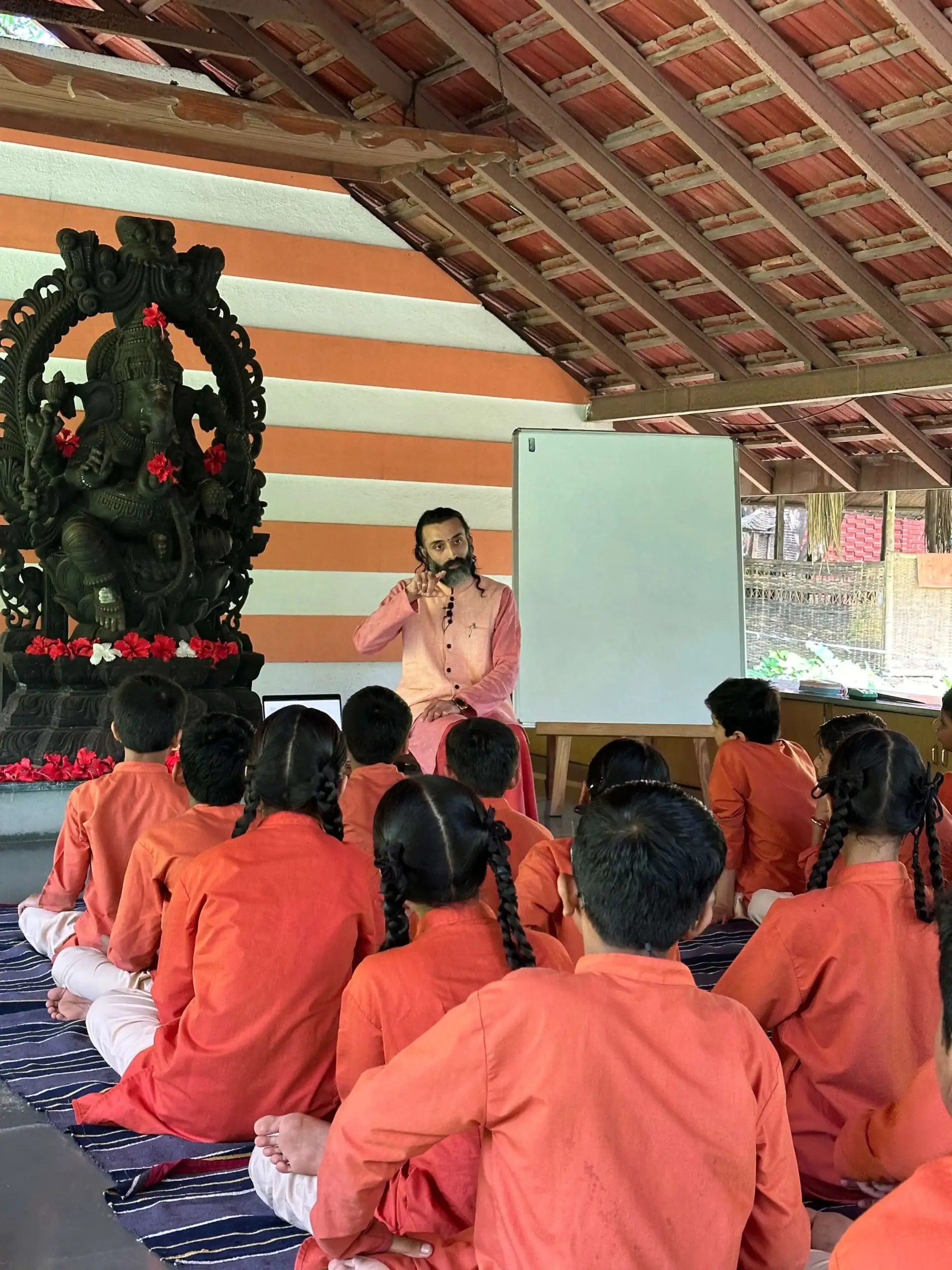
Ganesh Chaturthi at Sharada Prabha: Celebrating the Lord of Wisdom
Every year, as the month of Bhadrapada arrives, homes and streets across Bharat fill with the sound of “Ganapati Bappa Morya!” This year, Ganesh Chaturthi fell on Monday, 14 September 2026, and at Sharada Prabha, our children welcomed Lord Ganesha not just with devotion, but with understanding.
At Sharada Prabha, we celebrate the major festivals of Bharat with discussions on their cultural, spiritual and scientific significance. A festival becomes truly alive for a child when they know the why behind the what.
Why is Ganesh Chaturthi celebrated?
Ganesh Chaturthi marks the birth of Lord Ganesha, the elephant-headed son of Shiva and Parvati, remembered as the remover of obstacles and the god of wisdom and new beginnings. The festival falls on Chaturthi, the fourth day of the waxing moon (Shukla Paksha), in the Hindu month of Bhadrapada.
The Puranic accounts of Ganesha’s birth vary. In the most popular telling, Goddess Parvati creates a child and asks him to guard her door. When Shiva returns and is stopped by the boy, who does not know him, a conflict follows in which the boy loses his head. Moved by Parvati’s grief, Shiva restores the child’s life with the head of an elephant.
Another tradition says Ganesha was brought forth by Shiva and Parvati at the request of the devas, to place obstacles in the path of the rakshasas and to remove obstacles for the devas.
Traditional interpretations see deep symbolism here: the elephant head stands for the vastness of the cosmos, while the human form stands for the individual, whose journey is to grow towards that vastness.
A festival with a long history
No one knows exactly when Ganesh Chaturthi was first observed. Historical accounts tell us that Lord Ganesha was the family deity of the Peshwas, who patronised public celebrations in Pune in the 18th century. After Peshwa rule ended in 1818, the festival largely returned to the privacy of homes.
The modern public festival took shape in Pune in the early 1890s. Many accounts credit Bhausaheb Laxman Javale (Bhau Rangari) with installing the first sarvajanik (public) Ganesha idol in 1892. In 1893, Lokmanya Bal Gangadhar Tilak praised the public celebration in his newspaper Kesari and worked to turn it into a large, organised community festival. He saw in Ganesha a god for everybody, one who could bring people together across castes. Historians continue to discuss whether 1892 or 1893 should be marked as the beginning, which shows how layered the festival’s story is.
Across the map: from Maharashtra to Mauritius
Ganesh Chaturthi is celebrated across India. It is most elaborate in Maharashtra, Goa, Karnataka, Andhra Pradesh and Telangana, and is widely celebrated in Gujarat, Tamil Nadu, Odisha and Chhattisgarh as well.
In Maharashtra, the festival is celebrated for up to ten days and ends with a grand procession on Anant Chaturdashi.
In Goa, it is known as Chavath in Konkani.
In Karnataka, the Gowri festival comes just before Ganesh Chaturthi.
In Tamil Nadu, it is called Vinayagar Chaturthi, and in Andhra Pradesh and Telangana, Vinayaka Chavithi.
The festival has also travelled far beyond India. It is celebrated in Nepal and by Hindu communities in the United States, Canada, Mauritius, Singapore, Malaysia, Thailand, Fiji, Trinidad and Tobago, and Guyana.
How the festival unfolds
The celebrations begin with the installation of Lord Ganesha’s idol at home or in a community space, followed by daily prayers, aarti and offerings, with modak as his beloved sweet. The festival traditionally lasts up to ten days and concludes on Anant Chaturdashi, which fell on 25 September 2026 this year. The idol is then immersed in water (visarjan) with the chant “Ganapati Bappa Morya, Pudhchya Varshi Laukar Ya”, meaning “O Lord, come again soon next year.”
Our celebration at Sharada Prabha
Our children sat together in the presence of Lord Ganesha for a special learning session, listening and reflecting with curiosity and devotion.
What children learn from Lord Ganesha
Ganesha teaches children that wisdom begins with listening and humility, that every new beginning deserves a moment of reflection, and that obstacles are part of the path to growth. These values sit at the heart of our approach at Sharada Prabha, where we nurture children who are rooted in Bharatiya values and ready for the modern world.
Interested in seeing how learning looks at Sharada Prabha? Book a campus visit or call us at +91 90813 33564.
Ganapati Bappa Morya!